 Florentis
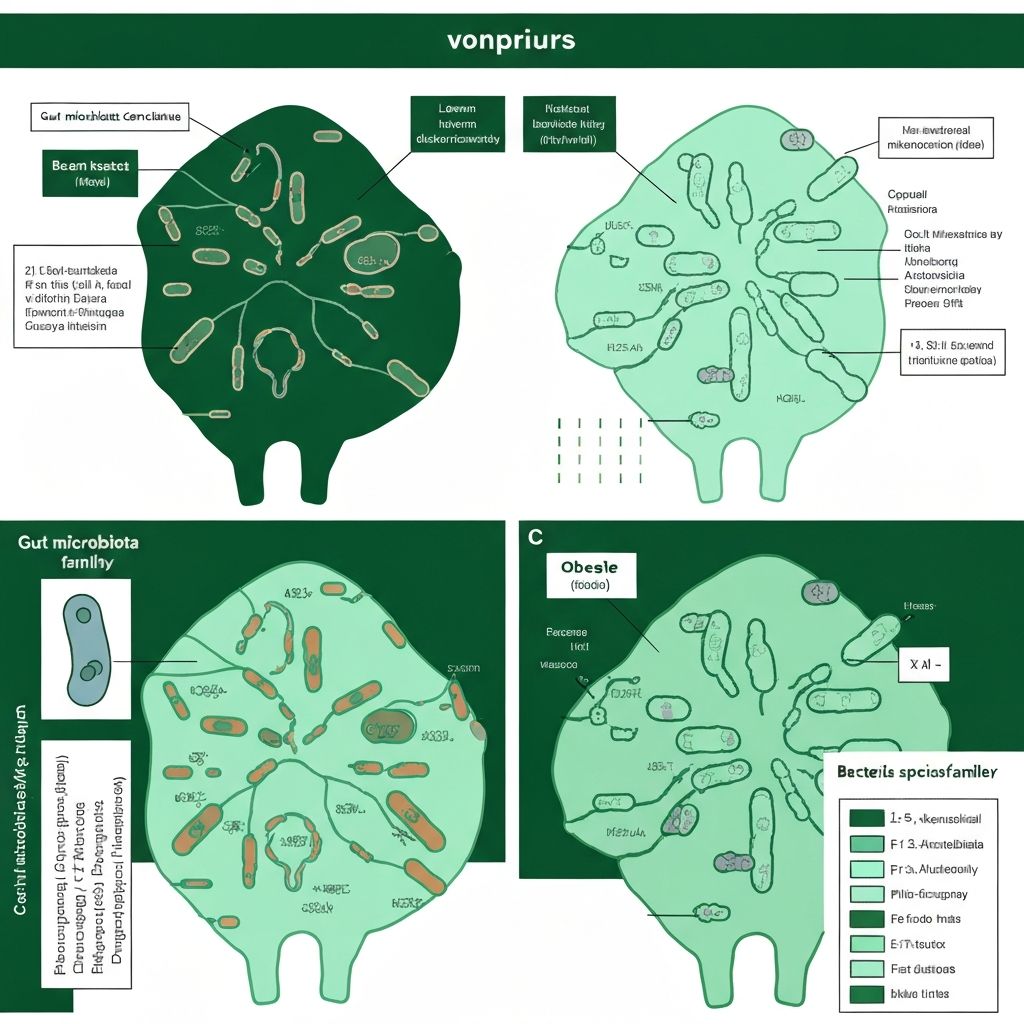
Gut Microbiota Composition in Lean vs Obese Individuals
Cross-sectional and longitudinal studies have documented associations between microbial community composition and body weight status. These observational findings have generated substantial research effort aimed at identifying specific taxonomic markers, diversity metrics, and functional capacities that correlate with obesity, though causality remains contested.
The Firmicutes/Bacteroidetes Hypothesis
One of the most widely cited observations in microbiota research is an elevated Firmicutes to Bacteroidetes (F/B) ratio in obese compared to lean individuals. This finding emerged from seminal studies comparing 12 obese and 12 lean individuals using early molecular techniques, and was replicated in several subsequent studies.
The mechanistic hypothesis proposed that Firmicutes are more efficient at extracting energy from dietary polysaccharides, converting them to short-chain fatty acids and other metabolites with higher bioenergetic yield. An elevated F/B ratio would theoretically result in increased energy harvest from food, promoting positive energy balance and weight gain.
However, subsequent investigations reveal substantial inconsistency. Multiple large-scale studies fail to replicate the F/B association with obesity across diverse populations. Meta-analyses report heterogeneous results, with effect sizes ranging from non-significant to modest, and substantial between-study variation. Some populations show no association or even inverse relationships. This variability likely reflects differences in sequencing methodologies, analytical pipelines, population demographics, and dietary patterns.
Bacterial Diversity Metrics
An alternative microbiota-obesity association concerns reduced bacterial richness and diversity in obese individuals. Alpha diversity metrics (within-sample diversity) including the Chao1 index and Shannon index are often lower in obese versus lean populations. This reduced diversity has been hypothesised to reflect functional loss—fewer distinct bacterial taxa imply reduced metabolic redundancy and functional capacity.
However, the ecological and metabolic significance of this pattern remains debated. Some studies show no consistent relationship between alpha diversity and body weight. The directionality is unclear: does low diversity predispose to obesity, or does obesity (through altered diet and intestinal environment) reduce diversity secondarily?
Specific Taxonomic Associations
Beyond phylum-level ratios, specific operational taxonomic units (OTUs) and genera have been associated with body weight variation. Akkermansia muciniphila, a mucin-degrading bacterium, is frequently more abundant in lean individuals and inversely correlates with obesity markers in several studies. This bacterium's role in intestinal barrier integrity and mucus layer maintenance suggests a potential protective mechanism.
Faecalibacterium prausnitzii, a major butyrate producer, is often reduced in obese populations and in individuals with metabolic disease. Similarly, other recognised SCFA-producing bacteria (Roseburia spp., Eubacterium spp.) are frequently depleted in obesity-associated dysbiosis.
Conversely, certain Proteobacteria (including gram-negative species with high lipopolysaccharide content) are sometimes elevated in obese microbiota, potentially contributing to increased LPS translocation and systemic endotoxemia.
These associations suggest that obesity-associated dysbiosis reflects a shift away from SCFA producers and mucin-supporting bacteria towards potentially pro-inflammatory or energy-harvesting species, though causality and functional relevance remain incompletely characterised.
Beta Diversity and Community Structure
Beta diversity analyses—measuring between-sample differences in microbial community composition—reveal that obese and lean individuals harbour detectably different microbial communities on average. However, substantial overlap exists; many obese individuals have microbiota compositions resembling lean controls, and vice versa. This observation underscores that whilst microbiota composition and body weight are statistically associated, the relationship is neither deterministic nor specific to obesity.
Methodological and Ecological Confounding
Substantial limitations constrain inference from these observational studies. Cross-sectional designs cannot establish direction of causality. Reverse causality—wherein weight gain drives microbiota change through altered diet and intestinal physiology—remains highly plausible.
Ecological confounding is pervasive. Individuals differing in body weight systematically differ in diet quality, physical activity, medication use (particularly antibiotics), socioeconomic factors, and stress levels—all of which independently influence both microbiota and metabolism. Disentangling direct microbiota effects from these confounders is methodologically challenging.
Measurement heterogeneity across studies complicates synthesis. Different DNA extraction protocols, sequencing platforms (16S rRNA vs shotgun metagenomics), taxonomic assignment methods, and analytical pipelines produce non-comparable datasets. This technical variability contributes substantially to inconsistent findings across studies.
Longitudinal Evidence and Stability
Prospective investigations tracking microbial changes during weight loss or weight gain provide insights into microbiota plasticity. Weight loss interventions consistently produce measurable shifts in microbial community composition and increased SCFA-producing bacteria abundance. These changes are rapid (weeks to months) and partially reversible upon dietary reversion, demonstrating the dynamic nature of the microbiota.
Certain baseline microbial features have been associated with weight loss success in some studies, suggesting that microbiota composition may predict treatment response. However, these associations remain modest and inconsistently replicated across populations and interventions.
Population Heterogeneity and Subgroups
Mounting evidence suggests substantial heterogeneity in microbiota-obesity associations across populations. Ethnicity, geographic location, and dietary tradition contribute to baseline microbial composition variation, which in turn affects the microbiota-weight relationship. Findings robust in one population may not generalise to another.
This heterogeneity complicates the identification of universal microbiota-obesity biomarkers and suggests that any future microbiota-targeted interventions would require personalised approaches accounting for population context and individual microbiota profiles.
Current Evidence and Limitations
Converging evidence indicates that body weight and microbial composition co-vary, with obese populations exhibiting measurable average differences in diversity metrics, specific taxa abundance, and functional capacities. These associations are consistent with hypothesised mechanisms linking dysbiosis to metabolic dysfunction. However, substantial individual variation, modest effect sizes, and methodological heterogeneity across studies limit strong causal claims.
The field has evolved towards recognising that obesity-associated dysbiosis likely reflects both primary dysbiosis-driven effects (wherein altered microbiota contribute to weight gain) and secondary adaptations (wherein weight gain and altered diet reshape the microbiota). Bidirectional causality is probable.